
In the Fine-Tuning section, we built reward models that score complete responses. Give it a prompt and response, get a number: “this response is good” or “this response is bad.”
That’s an Outcome Reward Model (ORM). It judges the destination, not the journey.
But for reasoning, the journey matters. A correct answer reached through flawed logic is a ticking time bomb. A Process Reward Model (PRM) scores each step along the way.
ORM vs PRM
Consider this math solution:
Problem: What's 15% of 80?

Step 1: 15% means 15/100 = 0.15          ✓ (correct)
Step 2: Multiply: 0.15 × 80               ✓ (correct approach)
Step 3: 0.15 × 80 = 15 × 8 = 120         ✗ (wrong! should be 12)
Step 4: Wait, that's too high. Let me check: 0.15 × 80 = 12  ✓
Final answer: 12                          ✓ (correct)
ORM sees: Final answer is 12. Correct! Score: high.
PRM sees: Step 3 was wrong, but Step 4 caught and fixed it. Scores:
Step 1: 1.0 (correct)
Step 2: 1.0 (correct)
Step 3: 0.0 (error!)
Step 4: 1.0 (good correction)
The PRM gives us much more information. We know exactly where the reasoning went wrong.
Why PRMs Matter
From OpenAI’s “Let’s Verify Step by Step” paper:
Process supervision has several alignment advantages over outcome supervision. It directly rewards the model for following an aligned chain-of-thought, since each step in the process receives precise supervision.
Three key benefits:
1. Better Error Detection
ORMs can be fooled by wrong answers that “look right.” PRMs catch logical errors even when the final answer happens to be correct.
2. More Precise Feedback
When training with RL, an ORM says “this whole response was good/bad.” A PRM says “this specific step was the problem.” Dense rewards lead to faster, more stable learning.
3. Interpretability
You can see where the model’s reasoning breaks down. Useful for debugging and building trust.
The numbers: on the MATH benchmark, OpenAI’s PRM achieved 78.2% accuracy vs 72.4% for their best ORM. A significant gap.
import torch
import torch.nn as nn
import torch.nn.functional as F
from transformers import AutoModel, AutoTokenizer
from dataclasses import dataclass
from typing import List, Tuple
import numpy as np
import matplotlib.pyplot as plt

# Load base model for our PRM
# We'll use the base Qwen model (not instruct) as the backbone
model_name = "Qwen/Qwen2.5-0.5B"
print(f"Loading {model_name} as base for PRM...")

tokenizer = AutoTokenizer.from_pretrained(model_name)
base_model = AutoModel.from_pretrained(model_name, dtype="auto")

if torch.cuda.is_available():
    device = "cuda"
elif torch.backends.mps.is_available():
    device = "mps"
else:
    device = "cpu"
base_model = base_model.to(device)

print(f"Loaded on {device}")
Loading Qwen/Qwen2.5-0.5B as base for PRM...
Loaded on cuda
PRM Architecture
A PRM is similar to an ORM (from our reward modeling notebook), but with one key difference: it outputs a score for each step, not just one score for the whole response.
The architecture:
Input: [problem] [step 1] [step 2] ... [step N]
              │       │        │           │
              ▼       ▼        ▼           ▼
       ┌─────────────────────────────────────┐
       │          Base Language Model        │
       │         (GPT, LLaMA, etc.)          │
       └─────────────────────────────────────┘
              │       │        │           │
              ▼       ▼        ▼           ▼
            h_0     h_1      h_2         h_N   (hidden states)
                      │        │           │
                      ▼        ▼           ▼
                   score_1  score_2    score_N  (via value head)
We need to:
Identify where each step ends in the token sequence
Extract the hidden state at those positions
Run each through a value head to get step scores
class ProcessRewardModel(nn.Module):
    """
    Process Reward Model — scores each reasoning step.

    Unlike an ORM which gives one score for the whole response,
    a PRM gives a score for each step in the reasoning chain.
    """

    def __init__(self, base_model, hidden_size: int,
                 step_separator: str = "\n"):
        super().__init__()
        self.base_model = base_model
        self.step_separator = step_separator

        # Value head: maps hidden state → step score
        # Use same dtype as base model for compatibility
        self.value_head = nn.Sequential(
            nn.Dropout(0.1),
            nn.Linear(hidden_size, 1)
        )

    def find_step_positions(self, input_ids: torch.Tensor,
                            tokenizer) -> List[List[int]]:
        """
        Find the token positions where each step ends.

        We look for newline tokens (or whatever separator is used)
        and return their positions.

        Args:
            input_ids: Token IDs, shape (batch, seq_len)
            tokenizer: The tokenizer (to find separator token)

        Returns:
            List of lists: step end positions for each sequence
        """
        # Get token ID for the separator
        sep_ids = tokenizer.encode(self.step_separator, add_special_tokens=False)

        batch_positions = []
        for seq in input_ids:
            positions = []
            for i, token_id in enumerate(seq):
                if token_id.item() in sep_ids:
                    positions.append(i)
            # Also include the last position (end of sequence)
            seq_len = (seq != tokenizer.pad_token_id).sum().item()
            if seq_len - 1 not in positions:
                positions.append(seq_len - 1)
            batch_positions.append(positions)

        return batch_positions

    def forward(self, input_ids: torch.Tensor,
                attention_mask: torch.Tensor,
                tokenizer) -> Tuple[torch.Tensor, List[List[int]]]:
        """
        Compute step-level scores.

        Args:
            input_ids: Token IDs
            attention_mask: Attention mask
            tokenizer: Tokenizer for finding step boundaries

        Returns:
            (step_scores, step_positions)
            step_scores is a list of tensors (one per sequence)
        """
        # Get hidden states from base model
        outputs = self.base_model(
            input_ids=input_ids,
            attention_mask=attention_mask,
            output_hidden_states=True
        )
        hidden_states = outputs.last_hidden_state  # (batch, seq, hidden)

        # Find step positions
        step_positions = self.find_step_positions(input_ids, tokenizer)

        # Extract hidden states at step positions and compute scores
        all_scores = []
        for batch_idx, positions in enumerate(step_positions):
            step_hidden = hidden_states[batch_idx, positions, :]  # (n_steps, hidden)
            # Cast to float32 for value head computation, then back
            scores = self.value_head(step_hidden.float()).squeeze(-1)  # (n_steps,)
            all_scores.append(scores)

        return all_scores, step_positions


# Create PRM
prm = ProcessRewardModel(
    base_model=base_model,
    hidden_size=base_model.config.hidden_size,
    step_separator="\n"
)
prm = prm.to(device)

print(f"PRM created with {sum(p.numel() for p in prm.value_head.parameters()):,} value head parameters")
PRM created with 897 value head parameters
# Test the PRM on example reasoning
test_text = """Problem: What is 2 + 3?
Step 1: I need to add 2 and 3.
Step 2: 2 + 3 = 5.
Answer: 5"""

inputs = tokenizer(test_text, return_tensors="pt", padding=True).to(device)

with torch.no_grad():
    scores, positions = prm(
        inputs["input_ids"],
        inputs["attention_mask"],
        tokenizer
    )

print("Test input:")
print(test_text)
print("\n" + "="*50)
print("\nStep scores (before training - essentially random):")

# Split text into steps for display
steps = test_text.split('\n')
for i, (step, score) in enumerate(zip(steps, scores[0])):
    print(f"  Step {i}: {score.item():.4f} — {step[:40]}...")
Test input:
Problem: What is 2 + 3?
Step 1: I need to add 2 and 3.
Step 2: 2 + 3 = 5.
Answer: 5
==================================================
Step scores (before training - essentially random):
Step 0: -2.6157 — Problem: What is 2 + 3?...
Training a PRM
Training data for PRMs looks different from ORMs. Instead of:
(prompt, response_good, response_bad)We need:
(prompt, solution_steps, step_labels)Where step_labels marks each step as correct (+1) or incorrect (-1).
Where does this data come from?
Human annotation: Pay people to label each step (expensive but high quality)
Automatic labeling: Use final answer correctness + heuristics
Monte Carlo estimation: Sample many continuations from each step, see which lead to correct answers
OpenAI’s PRM800K dataset used human annotation — 800,000 step-level labels. That’s a lot of work!
@dataclass
class PRMTrainingSample:
    """A training sample for the Process Reward Model."""
    problem: str
    steps: List[str]
    labels: List[int]  # +1 for correct, -1 for incorrect

    def to_text(self) -> str:
        """Convert to text format."""
        text = f"Problem: {self.problem}\n"
        for i, step in enumerate(self.steps):
            text += f"Step {i+1}: {step}\n"
        return text.strip()


# Create some synthetic training data
# In practice, you'd load this from a dataset like PRM800K

train_samples = [
    PRMTrainingSample(
        problem="What is 5 + 7?",
        steps=[
            "I need to add 5 and 7.",
            "5 + 7 = 12.",
            "The answer is 12."
        ],
        labels=[1, 1, 1]  # All correct
    ),
    PRMTrainingSample(
        problem="What is 8 × 3?",
        steps=[
            "I need to multiply 8 by 3.",
            "8 × 3 = 21.",  # Wrong!
            "The answer is 21."
        ],
        labels=[1, -1, -1]  # Step 2 is wrong, so step 3 is also wrong
    ),
    PRMTrainingSample(
        problem="What is 10 - 4?",
        steps=[
            "I need to subtract 4 from 10.",
            "10 - 4 = 6.",
            "The answer is 6."
        ],
        labels=[1, 1, 1]  # All correct
    ),
    PRMTrainingSample(
        problem="What is 15 / 3?",
        steps=[
            "I need to divide 15 by 3.",
            "15 / 3 = 3.",  # Wrong! Should be 5
            "Wait, let me recalculate: 15 / 3 = 5.",
            "The answer is 5."
        ],
        labels=[1, -1, 1, 1]  # Caught the error
    ),
]

print(f"Created {len(train_samples)} training samples")
print("\nExample sample:")
print(train_samples[1].to_text())
print(f"Labels: {train_samples[1].labels}")
Created 4 training samples
Example sample:
Problem: What is 8 × 3?
Step 1: I need to multiply 8 by 3.
Step 2: 8 × 3 = 21.
Step 3: The answer is 21.
Labels: [1, -1, -1]
The PRM Loss Function
How do we train the PRM? We could use simple binary cross-entropy on each step:
Where:
is the raw score for step
is the label (1 for correct, 0 for incorrect)
is the sigmoid function
But there’s a subtlety. Steps aren’t independent! If step 3 is wrong, everything after it is probably wrong too. We might want to:
Weight later steps more heavily (they’re harder to get right)
Mask steps after the first error (they’re “tainted”)
Use a ranking loss between correct and incorrect steps
For simplicity, we’ll use weighted binary cross-entropy.
def prm_loss(step_scores: List[torch.Tensor],
             step_labels: List[List[int]],
             pos_weight: float = 1.0) -> torch.Tensor:
    """
    Compute PRM training loss.

    Uses binary cross-entropy for each step.

    Args:
        step_scores: List of score tensors (one per sequence)
        step_labels: List of label lists (+1 correct, -1 incorrect)
        pos_weight: Weight for positive examples

    Returns:
        Average loss across all steps
    """
    total_loss = 0.0
    n_steps = 0

    for scores, labels in zip(step_scores, step_labels):
        # Convert labels from [-1, 1] to [0, 1]
        targets = torch.tensor(
            [(l + 1) / 2 for l in labels],
            device=scores.device,
            dtype=torch.float
        )

        # Handle case where we have more positions than labels
        n = min(len(scores), len(targets))
        scores = scores[:n]
        targets = targets[:n]

        # Binary cross-entropy loss
        # We apply sigmoid inside BCEWithLogitsLoss for numerical stability
        loss = F.binary_cross_entropy_with_logits(
            scores, targets,
            pos_weight=torch.tensor([pos_weight], device=scores.device)
        )

        total_loss += loss * n
        n_steps += n

    return total_loss / max(n_steps, 1)


# Test the loss function
dummy_scores = [torch.tensor([0.5, -0.3, 0.8], device=device)]
dummy_labels = [[1, -1, 1]]

loss = prm_loss(dummy_scores, dummy_labels)
print(f"Example loss: {loss.item():.4f}")
Example loss: 0.4665
def train_prm_epoch(prm: ProcessRewardModel,
                    samples: List[PRMTrainingSample],
                    optimizer: torch.optim.Optimizer,
                    tokenizer) -> float:
    """
    Train PRM for one epoch.

    Args:
        prm: The process reward model
        samples: Training samples
        optimizer: The optimizer
        tokenizer: Tokenizer

    Returns:
        Average loss for the epoch
    """
    prm.train()
    total_loss = 0.0

    for sample in samples:
        # Tokenize
        text = sample.to_text()
        inputs = tokenizer(text, return_tensors="pt", padding=True).to(device)

        # Forward pass
        step_scores, _ = prm(
            inputs["input_ids"],
            inputs["attention_mask"],
            tokenizer
        )

        # Compute loss
        loss = prm_loss(step_scores, [sample.labels])

        # Backward pass
        optimizer.zero_grad()
        loss.backward()
        optimizer.step()

        total_loss += loss.item()

    return total_loss / len(samples)


# Train for a few epochs
optimizer = torch.optim.AdamW(prm.parameters(), lr=1e-4)

print("Training PRM...")
print("="*40)

for epoch in range(10):
    loss = train_prm_epoch(prm, train_samples, optimizer, tokenizer)
    if epoch % 2 == 0:
        print(f"Epoch {epoch+1}: Loss = {loss:.4f}")

print("\nTraining complete!")
Training PRM...
========================================
Epoch 1: Loss = 0.1088
Epoch 3: Loss = 0.0000
Epoch 5: Loss = 0.0000
Epoch 7: Loss = 0.0000
Epoch 9: Loss = 0.0000
Training complete!
# Test the trained PRM
prm.eval()

test_samples = [
    # Correct solution
    PRMTrainingSample(
        problem="What is 6 + 4?",
        steps=["I need to add 6 and 4.", "6 + 4 = 10.", "The answer is 10."],
        labels=[1, 1, 1]
    ),
    # Incorrect solution
    PRMTrainingSample(
        problem="What is 9 × 2?",
        steps=["I need to multiply 9 by 2.", "9 × 2 = 16.", "The answer is 16."],
        labels=[1, -1, -1]
    ),
]

print("Testing trained PRM:")
print("="*60)

for sample in test_samples:
    text = sample.to_text()
    inputs = tokenizer(text, return_tensors="pt", padding=True).to(device)

    with torch.no_grad():
        scores, _ = prm(inputs["input_ids"], inputs["attention_mask"], tokenizer)

    print(f"\nProblem: {sample.problem}")
    for i, (step, score, label) in enumerate(zip(sample.steps, scores[0], sample.labels)):
        prob = torch.sigmoid(score).item()
        correct = "✓" if label == 1 else "✗"
        print(f"  Step {i+1}: P(correct)={prob:.2f} [{correct}] {step[:35]}...")
Testing trained PRM:
============================================================
Problem: What is 6 + 4?
Step 1: P(correct)=1.00 [✓] I need to add 6 and 4....
Problem: What is 9 × 2?
Step 1: P(correct)=1.00 [✓] I need to multiply 9 by 2....
Aggregating Step Scores
Once we have step-level scores, we need to aggregate them into an overall solution score. Common approaches:
1. Minimum (most conservative)
If any step is wrong, the whole solution is suspicious.
2. Product (independence assumption)
Probability that all steps are correct, assuming independence.
3. Last step
If the final step is right, earlier steps were probably right too.
4. Weighted average
With weights decreasing for later steps (errors compound).
def aggregate_prm_scores(step_probs: torch.Tensor,
                         method: str = "min") -> float:
    """
    Aggregate step-level probabilities into a solution score.

    Args:
        step_probs: Probability of each step being correct
        method: Aggregation method ("min", "prod", "last", "mean")

    Returns:
        Overall solution score
    """
    if len(step_probs) == 0:
        return 0.0

    if method == "min":
        return step_probs.min().item()
    elif method == "prod":
        return step_probs.prod().item()
    elif method == "last":
        return step_probs[-1].item()
    elif method == "mean":
        return step_probs.mean().item()
    else:
        raise ValueError(f"Unknown method: {method}")


# Compare aggregation methods
# Simulated step probabilities: [0.95, 0.90, 0.30, 0.85]
# (Step 3 is suspicious)

step_probs = torch.tensor([0.95, 0.90, 0.30, 0.85])

print("Step probabilities:", [f"{p:.2f}" for p in step_probs.tolist()])
print("\nAggregation methods:")
print(f"  min:  {aggregate_prm_scores(step_probs, 'min'):.3f}  ← catches the bad step")
print(f"  prod: {aggregate_prm_scores(step_probs, 'prod'):.3f}  ← heavily penalized")
print(f"  last: {aggregate_prm_scores(step_probs, 'last'):.3f}  ← misses the error!")
print(f"  mean: {aggregate_prm_scores(step_probs, 'mean'):.3f}  ← smoothed")
Step probabilities: ['0.95', '0.90', '0.30', '0.85']
Aggregation methods:
min: 0.300 ← catches the bad step
prod: 0.218 ← heavily penalized
last: 0.850 ← misses the error!
mean: 0.750 ← smoothed
Using PRMs for Verification
Now let’s put it together: use the PRM to verify reasoning chains and select the best one.
class PRMVerifier:
    """
    Use a PRM to verify and rank reasoning chains.
    """

    def __init__(self, prm: ProcessRewardModel, tokenizer,
                 aggregation: str = "min"):
        self.prm = prm
        self.tokenizer = tokenizer
        self.aggregation = aggregation

    def score_solution(self, problem: str, steps: List[str]) -> dict:
        """
        Score a complete solution.

        Returns step scores and aggregated score.
        """
        # Format as text
        text = f"Problem: {problem}\n"
        for i, step in enumerate(steps):
            text += f"Step {i+1}: {step}\n"

        # Tokenize and score
        inputs = self.tokenizer(text, return_tensors="pt", padding=True)
        inputs = {k: v.to(next(self.prm.parameters()).device) for k, v in inputs.items()}

        self.prm.eval()
        with torch.no_grad():
            scores, _ = self.prm(
                inputs["input_ids"],
                inputs["attention_mask"],
                self.tokenizer
            )

        # Convert to probabilities
        step_probs = torch.sigmoid(scores[0][:len(steps)])
        overall_score = aggregate_prm_scores(step_probs, self.aggregation)

        return {
            "step_probs": step_probs.tolist(),
            "overall_score": overall_score,
            "weakest_step": step_probs.argmin().item(),
            "weakest_prob": step_probs.min().item()
        }

    def rank_solutions(self, problem: str,
                       solutions: List[List[str]]) -> List[dict]:
        """
        Rank multiple solutions by PRM score.

        Args:
            problem: The problem statement
            solutions: List of step lists

        Returns:
            Ranked list of (solution_idx, score_info) dicts
        """
        results = []
        for i, steps in enumerate(solutions):
            score_info = self.score_solution(problem, steps)
            score_info["solution_idx"] = i
            score_info["steps"] = steps
            results.append(score_info)

        # Sort by overall score (descending)
        results.sort(key=lambda x: x["overall_score"], reverse=True)
        return results


# Create verifier
verifier = PRMVerifier(prm, tokenizer, aggregation="min")
print("PRM Verifier ready.")
PRM Verifier ready.
# Test: rank multiple solutions to the same problem
problem = "What is 7 × 8?"

solutions = [
    # Solution 1: Correct
    [
        "I need to multiply 7 by 8.",
        "7 × 8 = 56.",
        "The answer is 56."
    ],
    # Solution 2: Wrong arithmetic
    [
        "I need to multiply 7 by 8.",
        "7 × 8 = 54.",  # Wrong!
        "The answer is 54."
    ],
    # Solution 3: Wrong but self-corrected
    [
        "I need to multiply 7 by 8.",
        "7 × 8 = 54.",  # Wrong
        "Wait, let me check: 7 × 8 = 56.",  # Corrected
        "The answer is 56."
    ],
]

print(f"Problem: {problem}")
print("\nRanking 3 different solutions...")
print("="*60)

ranked = verifier.rank_solutions(problem, solutions)

for rank, result in enumerate(ranked, 1):
    print(f"\nRank {rank}: Solution {result['solution_idx'] + 1}")
    print(f"  Overall score: {result['overall_score']:.3f}")
    print(f"  Step probs: {[f'{p:.2f}' for p in result['step_probs']]}")
    print(f"  Weakest: Step {result['weakest_step'] + 1} (p={result['weakest_prob']:.2f})")
    print(f"  Steps: {result['steps'][0][:30]}...")
Problem: What is 7 × 8?
Ranking 3 different solutions...
============================================================
Rank 1: Solution 1
Overall score: 1.000
Step probs: ['1.00']
Weakest: Step 1 (p=1.00)
Steps: I need to multiply 7 by 8....
Rank 2: Solution 2
Overall score: 1.000
Step probs: ['1.00']
Weakest: Step 1 (p=1.00)
Steps: I need to multiply 7 by 8....
Rank 3: Solution 3
Overall score: 1.000
Step probs: ['1.00']
Weakest: Step 1 (p=1.00)
Steps: I need to multiply 7 by 8....
Visualizing PRM Scores
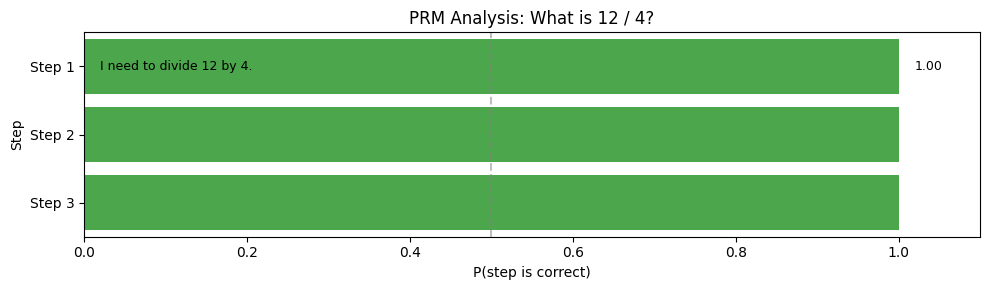
One of the great things about PRMs is interpretability. Let’s visualize where the model thinks errors might be.
def visualize_prm_scores(steps: List[str], probs: List[float],
                         title: str = "PRM Step Scores"):
    """
    Visualize PRM scores for a solution.
    """
    n_steps = len(steps)

    fig, ax = plt.subplots(figsize=(10, max(3, n_steps * 0.5)))

    # Create horizontal bar chart
    y_pos = np.arange(n_steps)
    colors = ['green' if p > 0.7 else 'orange' if p > 0.4 else 'red' for p in probs]

    bars = ax.barh(y_pos, probs, color=colors, alpha=0.7)

    # Add step labels
    for i, (step, prob) in enumerate(zip(steps, probs)):
        # Truncate long steps
        step_text = step[:50] + "..." if len(step) > 50 else step
        ax.text(0.02, i, step_text, va='center', fontsize=9)
        ax.text(prob + 0.02, i, f"{prob:.2f}", va='center', fontsize=9)

    ax.set_xlim(0, 1.1)
    ax.set_ylim(-0.5, n_steps - 0.5)
    ax.set_xlabel("P(step is correct)")
    ax.set_ylabel("Step")
    ax.set_title(title)
    ax.set_yticks(y_pos)
    ax.set_yticklabels([f"Step {i+1}" for i in range(n_steps)])
    ax.invert_yaxis()  # Top step first

    # Add threshold line
    ax.axvline(x=0.5, color='gray', linestyle='--', alpha=0.5)

    plt.tight_layout()
    plt.show()


# Visualize a solution with an error
problem = "What is 12 / 4?"
steps = [
    "I need to divide 12 by 4.",
    "12 / 4 = 4.",  # Wrong! Should be 3
    "The answer is 4."
]

result = verifier.score_solution(problem, steps)

print(f"Problem: {problem}")
print(f"(Correct answer: 3)")
visualize_prm_scores(steps, result["step_probs"],
                     title=f"PRM Analysis: {problem}")
Problem: What is 12 / 4?
(Correct answer: 3)
What We’ve Learned
Process Reward Models provide step-level supervision:
Architecture: Base LM + value head, scoring at step boundaries
Training: Binary classification on step correctness
Aggregation: Combine step scores (min, product, mean, last)
Verification: Rank solutions by PRM score
Key insight from OpenAI:
Process supervision leads to significantly better performance, even when judged by outcomes.
The math:
PRMs are essential for:
Guiding search (which path is promising?)
Best-of-N selection (which solution is most reliable?)
RLHF with dense rewards (step-level feedback)
Next up: Best-of-N with verification — using PRMs to select the best solution from many candidates